
Author: @atilayberber
Here’s something everyone who works with Power BI knows but rarely says out loud: a company’s definition of “Net Revenue,” “Active Customer” or “Gross Margin” very often lives inside a Power BI semantic model, written in DAX. Power BI reports can use it. People connecting from Excel can use it. But a Python notebook, a team working in Snowflake, or an AI agent running on another platform can’t reach that definition directly. They either copy it or write their own.
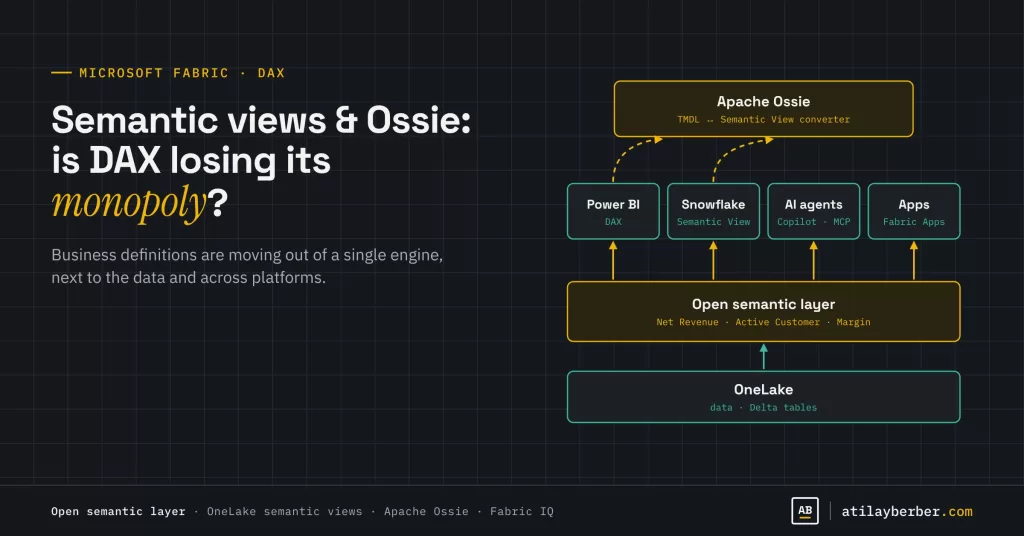
Two developments in September and October 2026 started to put that arrangement into question: OneLake semantic views, shown by Microsoft as a sneak peek at FabCon Barcelona, and Apache Ossie, an open standard now backed by both Microsoft and Snowflake. The question is whether business logic is moving out of DAX and into an open, cross-platform layer. And if it is, does that mean the end of DAX?
What’s in this post
- What I mean by the “semantic monopoly,” and why it’s being debated now
- OneLake semantic views: what we know and what we don’t
- Apache Ossie: Snowflake and Microsoft at the same table
- Fabric IQ ontology: a third layer that reuses your DAX
- The two camps: “an open semantic layer is inevitable” vs. “nothing replaces DAX”
- My take: the monopoly is shifting from the language to the definitions
- What you can do to prepare today
What is the “semantic monopoly”?
The semantic model is the translator between raw tables and business questions. When someone says “sales,” which column in which table, with which filters, in which currency? You define it once, and everyone sees the same number. A big part of Power BI’s success over the past decade comes from this layer.
The problem is that for a long time this layer was tied to a single engine. A DAX measure is a language only the Analysis Services engine understands. Any other tool that wants that measure has to query the Power BI semantic model (via XMLA or a DAX query) or rewrite the logic in its own language. That’s why so many organizations end up with four versions of the same KPI living in Power BI, dbt, a Python script and an Excel workbook.
AI agents made this worse. If an agent is going to answer “what was net revenue last quarter?”, it needs the definition of net revenue. If that definition is locked inside one platform, every agent outside it is guessing.
OneLake semantic views: what we know and what we don’t
Microsoft showed semantic views in Barcelona as a sneak peek only. The idea is to take business definitions out of the Power BI semantic model and bring them down to the OneLake level, next to the data. The same definition could then be reused across analytics, applications, AI agents and potentially other platforms.
James Serra’s roundup gives a clean example: today, “Net Revenue” is a DAX measure inside a Power BI model. With semantic views, the goal would be to define that business meaning once near the OneLake data and stop recreating it for every model, app and agent.
What we don’t know outweighs what we do. Microsoft hasn’t yet documented:
- How calculations will be defined (DAX? SQL? something else?)
- How security (RLS/OLS) will apply
- Which engine will execute queries
- How semantic views will coexist with Power BI semantic models
That’s why Serra reads semantic views not as a replacement for semantic models but as an open, reusable layer beneath or alongside them. I agree, but it’s worth remembering the difference between “not documented yet” and “not going to happen.”
Apache Ossie: Snowflake and Microsoft at the same table
The second development is more concrete. Apache Ossie is an open, vendor-neutral standard for semantic definitions such as metrics and dimensions. It began life as the Open Semantic Interchange (OSI) initiative and is now incubating at the Apache Software Foundation. According to Snowflake, 48 organizations joined in its first six months.
For Power BI people, the important parts are these:
- The first Power BI converter has shipped. Using Ossie as the intermediate format, it aims to convert between Power BI semantic models and other Ossie-compatible models such as Snowflake Semantic Views. On the Microsoft side it targets TMDL (Tabular Model Definition Language).
- DAX is being added to the spec as a recognized query expression language, so Microsoft measure logic can be represented in Ossie models. Snowflake presents this as work under review, not a finished capability.
- Microsoft leadership has publicly committed to the project, and Microsoft engineers have joined the community.
There’s a subtle but important point here. The stated goal is mapping definitions “without loss of expression.” How close that gets is still an open question. A simple SUM measure is easy. A measure that shifts context with CALCULATE, leans on time intelligence functions or depends on calculation groups behaving identically on another platform is a much harder problem.
Fabric IQ ontology: a third layer that reuses your DAX
The third piece is Fabric IQ ontology, now in public preview. An ontology defines business concepts like customers, products, orders and stores, and the relationships between them. The key detail: it can reuse existing Power BI semantic model definitions, including DAX measures and calculated columns, rather than forcing you to rebuild the logic. It also supports RDF/OWL import and export.
So Microsoft’s current direction isn’t “throw away your DAX.” It’s “reuse the definitions you wrote in DAX in a much wider context.” That detail changes the tone of the whole debate.
The two camps
Camp 1: “An open semantic layer is inevitable”
This camp has strong arguments:
- Data platforms are no longer single-vendor. Fabric, Snowflake, Databricks and BigQuery live side by side. Locking definitions into one engine keeps getting more expensive.
- AI agents are everywhere: Copilot Chat, Copilot Studio, Snowflake Cortex, your own apps. They all need the same definition of net revenue.
- Microsoft backing the same standard as Snowflake signals that competition will move from semantic lock-in to semantic quality.
Camp 2: “Nothing replaces DAX”
The counterarguments aren’t trivial either:
- DAX’s power is filter context and context transition. If a shared intermediate format has to settle for the lowest common denominator, complex measures will be lost or mistranslated.
- Semantic views is an undocumented sneak peek. Ossie is incubating and its DAX support is under review. Making production decisions based on sneak peeks is risky.
- A Power BI semantic model isn’t just definitions. It’s a compressed in-memory engine, security and performance. None of that moves into an open standard.
My take: the monopoly is shifting from the language to the definitions
DAX isn’t dying. For Power BI reports, Direct Lake models and complex analytical measures, it will remain the primary language for years. New investments like DAX user-defined functions make that clear.
But something has changed: value is accumulating in the definitions, not in the language. Five years ago, writing good DAX was a specialty on its own. Going forward, the real expertise will be making sure the definition of “Net Revenue” is correct, documented, tested and portable across platforms. DAX will remain one of the most powerful ways to express that definition. It just won’t own it anymore.
A retail example: in a grocery chain there are at least three definitions of “revenue” floating around. Till revenue including VAT, net sales excluding VAT, and net revenue after returns and discounts. Today they live separately in a Power BI model, in finance’s Excel and in the e-commerce team’s SQL. The real promise of an open semantic layer isn’t technology, it’s ending that chaos. But if the organization never decides which definition is right, no standard will make that decision for it.
What you can do to prepare today
- Move your models to text formats. TMDL and PBIP are exactly what the Ossie converter targets. If your model lives in Git as text, every future conversion gets easier.
- Write descriptions for your measures. You can’t make a definition portable if nobody wrote down what it means.
- Build a definitions inventory. What are your 20 most critical KPIs, where is each defined, and how many versions exist?
- Manage complexity on purpose. Avoid overly clever DAX where it isn’t needed. Simpler definitions travel better.
- Follow Ossie, but don’t bet production on it. The spec and the converter are moving fast.
Conclusion
OneLake semantic views and Apache Ossie don’t signal the end of DAX. They signal the beginning of the end of the semantic monopoly. Business definitions are moving from being locked inside one engine toward living next to the data and across platforms. The winners won’t be the people who write the cleverest DAX, but the organizations with the clearest definitions.
Where do you stand? Is business logic leaving Power BI an opportunity or a loss of control? Let’s talk in the comments or on LinkedIn.
Sources
- Breaking Down Semantic Silos: Microsoft Ecosystem Support Comes to Apache Ossie (Snowflake)
- Announcements from FabCon Barcelona 2026 (James Serra)
- Fabric IQ ontology overview (Microsoft Learn)
STAY IN THE LOOP
New guides, sorted by topic in a single email.
Every Monday, the week's new posts arrive grouped by topic. No new posts, no email.