

Author: @atilayberber
The Power BI world has repeated one line for years: “The semantic model is the single source of truth.” Measures are defined there, relationships live there, and reports are built on it.
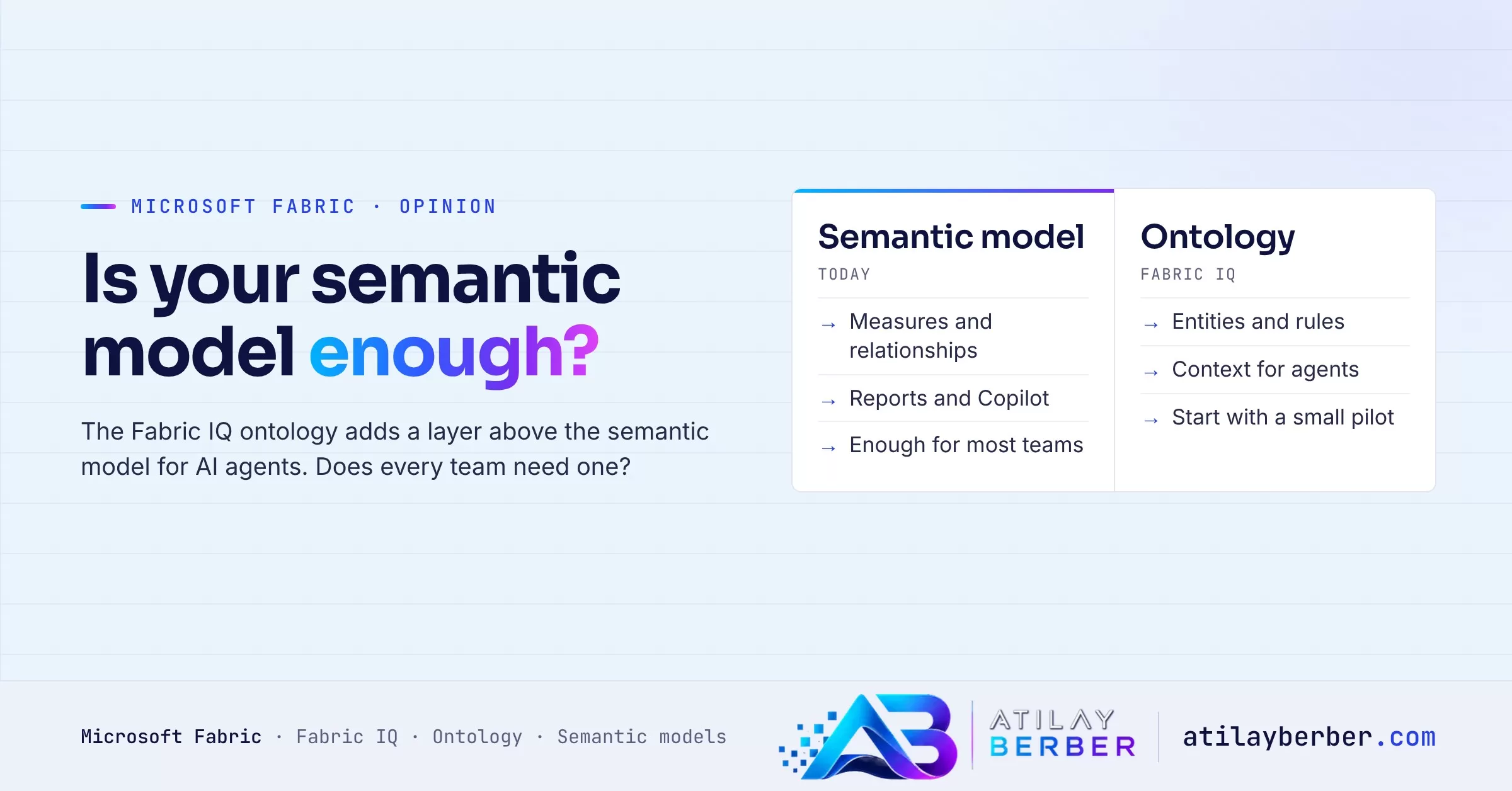
Now Microsoft is adding another layer on top: the Fabric IQ ontology. This preview feature defines business concepts (customer, order, store, shipment), the relationships between them and the business rules, in a shared language that AI agents can understand.
So the question is unavoidable: Is the semantic model no longer enough? Does every team need an ontology?
In short
- An ontology is a meaning layer that defines business concepts, relationships, rules and metrics and binds them to live data. It doesn’t move data and isn’t a new query engine.
- It can be generated from an existing semantic model. DAX measures show up as “metrics” in the ontology, but their definitions stay in the semantic model.
- The ontology is still in preview, and Fabric IQ’s own status is described differently depending on the source.
- An ontology makes a difference when different systems define the same concept differently, and when the question isn’t “how much?” but “what is this, who owns it, which rule applies?”
- My take: if you have one good model and one agent, you don’t need it yet. If you have a weekly question that spans several systems, it’s worth starting a small pilot.
What exactly is an ontology?
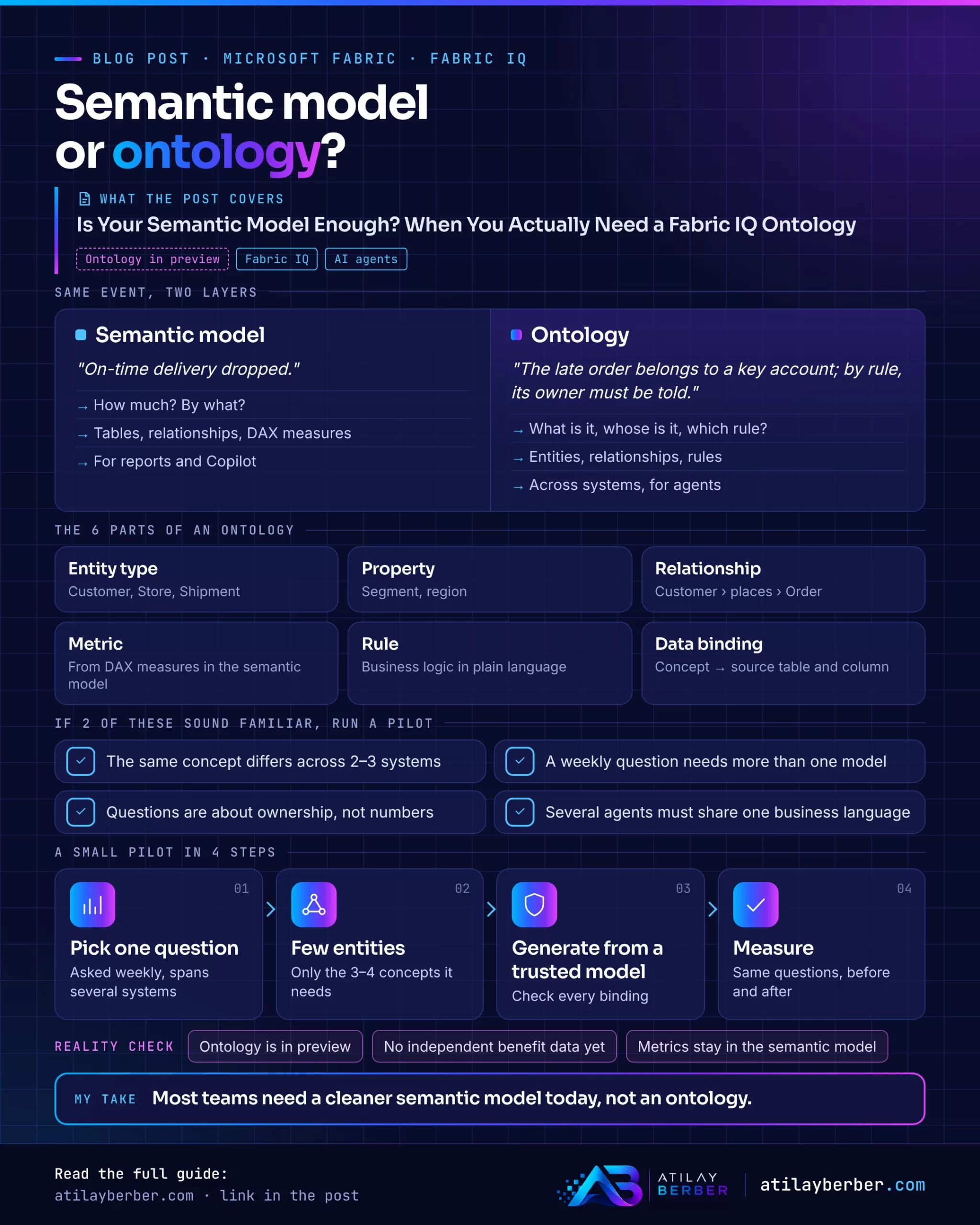
Microsoft Learn defines it as a shared, machine-readable model of the business. Here are the parts:
| Part | What it does | Example |
|---|---|---|
| Entity type | A reusable business concept | Customer, Store, Shipment |
| Property | A typed attribute of an entity | Customer segment, store region |
| Relationship | An explicit link between entities | Customer › places › Order |
| Metric | A governed calculation | In the preview, comes from DAX measures in a semantic model |
| Rule | Business logic in natural language | “If a key account’s order is more than 24 hours late, notify the account owner.” |
| Data binding | Maps definitions to source tables and columns | Customer › the customer table in a lakehouse |
Sources can include semantic models, lakehouses, eventhouses, warehouses, SQL databases, mirrored databases and OneLake shortcuts. Data stays where it is, and queries go to the live source. On security, OneLake security and the source’s row-, object- and column-level rules apply.
There’s also an ontology agent. It reads connected sources and proposes definitions and bindings, but changes arrive as proposals and nothing applies until you approve it.
How is it different from a semantic model?
The best summary I found comes from a Microsoft consultancy’s example: the semantic model says “on-time delivery dropped.” The ontology says “the late order belongs to a key account, this is the account owner, and the rule says they need to be told.”
| Semantic model | Ontology | |
|---|---|---|
| The question it answers | How much? Compared to what? | What is this, who owns it, which rule applies? |
| Contents | Tables, relationships, DAX measures | Entities, properties, relationships, rules, metrics |
| Number of sources | Usually one model | Several systems |
| Main consumer | Reports, Copilot | Agents, operational scenarios |
The key point: the ontology doesn’t replace the semantic model. In the preview, metrics come from the semantic model’s DAX measures, and the semantic model owns the expression. Trusted KPIs still live in the semantic model.
The facts: what’s ready and what’s a promise
The gap between hype and reality is wide here, so it’s worth being precise:
- The ontology is in preview. The Microsoft Learn page says so plainly. The old ontology experience retires on January 31, 2027. Existing items move over by copying them into the new experience, but connected agents and dashboards have to be reconnected by hand.
- Fabric IQ’s status depends on who you ask. Microsoft announced Fabric IQ as generally available at Build 2026, yet the IQ workload page on Learn still carries a “preview” label.
- Generating from a semantic model has limits. An independent fact-check notes that ontologies generated from Import and DirectQuery models get the structure but not directly usable data bindings. Don’t plan without testing on your own model.
- The benefit hasn’t been measured. There’s no published independent figure for how much an ontology improves agent answers. Microsoft’s internal study is a vendor result.
- The operations agent has practical limits. One data source at a time, no trial capacities and some region restrictions are among them.
Two camps
“In the age of AI, a semantic model isn’t enough”
For this camp, the semantic model was designed for reports: measures, dimensions, hierarchies. An agent wants context, not just numbers: who is this customer, which contract are they under, who is responsible, which rule applies? If finance sees a customer as a legal entity and sales sees it as a group of contacts, an agent can’t tell it’s the same customer without a layer connecting the two definitions. That’s exactly the gap an ontology fills.
“Fundamentals first”
For this camp, an ontology is a new floor on a shaky building. An ontology generated from a model with undocumented measures, technical names and ambiguous relationships inherits the same problems. Everything from the post on why Copilot won’t fix a bad model applies here too. On top of that, it’s a preview feature, the experience is changing and the benefit hasn’t been measured. Fix the model first, then add layers.
My take
Both camps are right, just at different times.
I think most Power BI teams today don’t need an ontology; they need a better semantic model: business-friendly names, documented measures, a marked date table, clean relationships. Without those, an ontology just moves the problems somewhere else.
But there’s a threshold. If two of these are true for you, it’s worth trying an ontology now:
- The same concept (customer, product, store) is defined differently in two or three systems.
- A question asked every week can’t be answered from one model; it needs several systems.
- The questions are more about relationships and responsibility than numbers: “Who is affected by this delay?” “Which stores does this supplier problem reach?”
- Several agents need to speak the same business language.
If you have one good model with one data agent on top, an ontology adds very little today. Combined with the trend we discussed in the post on OneLake semantic views and Apache Ossie, the direction is clear: business definitions are moving out of a single engine and across the platform. But the pace of that move should be set by the maturity of your own data.
Starting with a small pilot
- Pick one question. Something someone asks every week that today needs several systems.
- Model only the entities you need. Not the whole business, just the three or four entities that question requires.
- Generate from a semantic model you trust. That keeps terms and KPIs consistent. Check the bindings one by one.
- Write the rules with the business owner. The ontology agent can propose, but the domain owner should confirm the meaning.
- Test with one agent and the person who asks the question. Look at which source each answer came from and how fresh the data was.
- Measure. Compare answers to the same set of questions before and after the ontology. If you see no benefit, don’t expand.
- Use a paid capacity. Preview limits can cause trouble on trial capacities and in some regions.
Conclusion
The ontology is an important part of what Microsoft is building for AI agents, and it’ll probably be talked about a lot more in the coming months. But it isn’t “the end of the semantic model.” A better reading is this: the semantic model stays home for the numbers, and the ontology explains which business reality those numbers belong to.
What do you think? Does your team need an ontology today, or a cleaner model? Let’s discuss in the comments.
Sources
- What Is Ontology (Preview)? Microsoft Learn
- What is Fabric IQ? Microsoft Learn
- Sparkle Solutions: Fabric IQ and ontology: when a semantic model is not enough
- Andreas Wasita: Fabric IQ Ontology V2, a preview briefing fact-checked
- James Serra: Announcements from the Microsoft Fabric Community Conference, Barcelona 2026
1 comments